Spring Statement offers some NIC relief for employees

The Spring Statement from Chancellor Rishi Sunak contained little of direct significance to the pensions industry, although to some surprise, he did unveil a significant increase in the earnings threshold at which employees start to pay National Insurance Contributions (NIC).
The primary threshold for the 2021/22 tax year was £9,564 and, from 6 July 2022, will become £12,570, aligning the NIC threshold with income tax for employees. Between 6 April and 5 July 2022, the threshold will be the previously announced figure of £9,880.
The three-month delay in implementing the more generous earnings threshold is to allow time for payroll operators to update their systems.
As explained in our story on page 2, this may also present an opportunity for employers to consider introducing salary exchange for pension contributions to offset some of the increased cost – for employers and employees – of the new NIC rates that cover the cost of the new Health and Social Care Levy.
How does the war in Ukraine affect pension schemes?

The Pensions Regulator (tPR) has acknowledged the global impact of the war in Ukraine and suggested that a “period of heightened uncertainty seems inevitable”. In a recent guidance note, tPR says that despite the short-term concerns, it recognises the long-term nature of pension investments and advises against “making hasty, uninformed decisions” regarding investment portfolios.
While the financial impact may not be too significant for most UK pension schemes, particularly when considered alongside the devastating impact on the daily lives of Ukraine’s citizens, trustees and scheme sponsors should however establish the potential impact on their schemes. Fortunately, most UK pension schemes have little, if any, direct or indirect exposure to Russian assets and fund managers have been able to identify and share the details with trustees.
Given the fall in value of Russian assets and the need to monitor and comply with sanctions and gover-nance requirements, some fund managers have al-ready written down scheme values to zero or an-nounced intentions to sell when practical to do so. Asking your investment consultant or fund managers about the actions they have taken is the natural first step for trust-ees. Of greater significance, particularly for defined benefit (DB) schemes, could be any direct operations of the em-ployer in Russia or Ukraine, which could adversely affect the employer covenant.

Pension salary exchange – why would you not use it?
Every UK company must provide their employees with ac-cess to a workplace pension scheme, but not all are aware of the advantages of using salary exchange (also known as salary sacrifice) for the employees’ pension contributions.
Now, with increased financial pressures on business, combined with increasing National Insurance Contributions (NIC), it may be time for another look at the potential savings available from the salary exchange option.
Salary exchange is an alternative way for employees to pay their contributions into a workplace pension scheme. It works for defined benefit (DB) and defined contribution (DC) schemes, including master trusts and group personal pension plans and can deliver significant savings for the employer and employees. It has been available for some years and is the most tax/NIC efficient way for employees to save for their retirement.
The concept of salary exchange is quite simple; instead of paying salaries and wages through PAYE and then deducting a percentage to cover the employee’s pension contributions (after NIC costs), the employee’s salary is reduced by the same amount as the pension contributions and the employer pays them direct to the scheme, in addition to the employer’s usual rate of contributions. As pension contributions do not attract NICs, a saving is made by both parties.
Whether the business objective is to save money or to enhance employee benefits, introducing salary exchange de-livers on both fronts and is now an approach adopted by many companies, large and small. An employee earning £30,000 and paying contributions at 5% would save al-most £200pa and the corresponding saving for the employ-er is around £226pa.
To discuss the potential benefits of salary exchange for your business, please contact us. We can conduct a feasibility study to assess the estimated savings available to you and your employees before you commit.
For enquires about salary exchange, please contact: George Bentham
Senior Consultant
Email: George.bentham@sandccarsalesharrogate.co.uk
Telephone: 07851 248 571


Time for a “stronger nudge” towards pen-sions guidance
Employers and trustees of defined contribution (DC) pension schemes are familiar with the free and impartial guidance service Pension Wise, available to anyone age 50 and over since the introduction of flexible retirement options in 2015.
This has always been – and will continue to be – an option for scheme members rather than a mandatory requirement when accessing retirement benefits. However, from 1 June 2022, due to concerns raised about the number of people accessing benefits with no guidance or advice, trustees and scheme managers will need to do more to promote the service. Members will have to take up the option or confirm their decision to opt out, before flexible benefits can be taken.
From June, any member applying for flexible retirement benefits must be offered an appointment with Pension Wise or Money Helper at a time to suit them.
Trustees are free to decide the point at which they give this “nudge”, but they must inform the member that the payment of benefits or transfer to another plan with the intention of taking flexible retirement benefits, cannot proceed until appropriate guidance has been received or the member confirms opt-out.
DC trust: a summary of the UK’s DC occupational pension schemes
The number of non-micro pension schemes has fallen by 63% over the past 10 years, with just 1,370 such schemes remaining, according to the latest edition of the Pensions Regulator’s DC trust.
The dramatic reduction has been driven by the need for employers to offer more modern schemes that comply with auto-enrolment requirements. Many schemes will have been wound up or transferred to an authorised master trust. In contrast, auto-enrolment has generated a huge increase in total membership of master trusts, from less than 300,000 members in 2012 to more than 20 million in 2021.
The Pensions Regulator (tPR) analyses data from scheme returns submitted in 2021/22 to provide a snapshot of the current landscape of defined contribution (DC) pension provision in the UK.
The DC trust covers 27,700 schemes as at 31 December 2021 and includes data on the number, memberships and assets of schemes, which are segmented into three catego-ries: the DC section of hybrid schemes, micro schemes with fewer than 12 members and non-micro schemes having 12 or more members.
Of the total number of schemes, some 26,260 – almost 95% – have fewer than 12 members and fall into the micro category. These are predominantly (22,530) small self-ad-ministered schemes (SSAS) and executive pension plans that were traditionally used in owner-managed businesses and other companies to provide flexible pension schemes for senior management.
There may be good reason for some of these to continue, but many are likely to be dormant schemes with no active members that will soon be the focus of tPR’s drive towards improved governance standards.
Non-micro schemes vs. master trusts
Of the non-micro schemes (excluding hybrid schemes and master trusts), almost half (660) of these have fewer than 100 members, which is still very small by pension scheme standards, and it would be no surprise if the transition to master trusts continues apace in the next few years.
Master trusts have the advantage of economies of scale, representing hundreds of thousands or even millions of members across thousands of employers in a single scheme.
That does not necessarily mean there is no place for small-er, independent schemes, but employers and trustees – and, potentially, tPR – will need to be convinced of the value for members and whether the cost of maintaining such a scheme represents best uses of the company’s time and money.
The future of UK pension schemes
Readers will be aware that private sector defined benefit (DB) pension schemes have been in decline for a number of years, so the future of UK pension schemes is definitely going to be DC for the majority of companies and their employees.
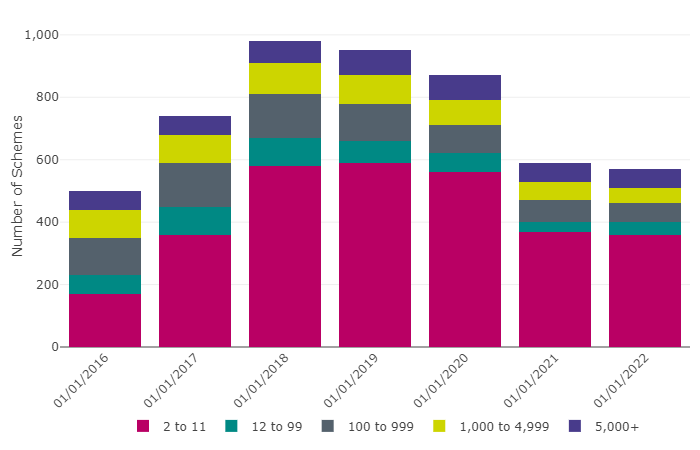
And it looks like a relatively small number of very large schemes is the most likely outcome, with Nest having attracted more than 10 million members in the past 10 years and an-other popular auto-enrolment scheme, the People’s Pension, now having more than five million members.
So, does this mean the end for all smaller independent pension schemes? We don’t think so, as many are well run and supported by employers who appreciate the value of a be-spoke pension arrangement for their employees.
Such schemes will, however, become the exception rather than the rule, and it is likely that generous contribution rates, competitive investment strategies, high standards of governance and a focus on communications and engagement will be required to ensure that the fortunate members of such schemes understand and appreciate what their employers are doing for them.
How MHM can help
We have a great deal of experience dealing with DC pension schemes and either provide advice and administration support to employers/trustees or, for those who would prefer to delegate responsibility for scheme governance to a professional, independent trustee, we can take on the trustee role through MHM Trustee Services Ltd.
Please get in touch to discuss the options available for your scheme.
Investment section
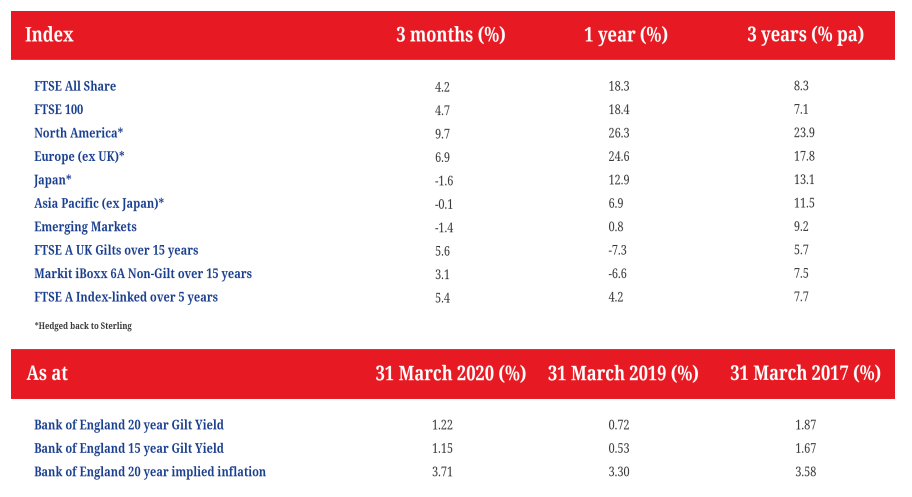
There were a number of key events to take note of for the final quarter of 2021, the discovery of the ‘Omicron’ variant impacted markets, COP26 held in Glasgow with world leaders pledging to cut carbon emission and, perhaps significant for some, the replacement of LIBOR (London Interbank Offered Rate) with SONIA (Sterling Overnight Index Average).
The impact of these events may still be playing out. However, if we look at the economy, inflation has been steadily rising along with energy costs and salaries. November saw a decade high UK CPI inflation rate of 5.1%, which has been exceeded since. Accompanying this, the Bank of England increased interest rates to 0.25%, which subsequently increased to 0.5% in February.
Despite these challenges, global equities ended 2021 on a high, delivering strong returns over the year.
Figures supplied by Barker Tatham Investment Consultants: BIG THINKING for small schemes

If the threat of increasing coronavirus cases was the lead story in January, this was quickly replaced in the headlines by the threat of Russia’s military build-up on its border with Ukraine, and the subsequent invasion on 24 February.
Aside of the devastating impact on the people of Ukraine, those countries – including the UK and much of Europe – that have depended heavily on Russia for energy supplies are now dealing with inflationary pressures caused by higher fuel prices and the impact this is having on households and businesses.
At the time of writing, we are into the sixth week of the Russia-Ukraine conflict and, with commentators suggesting that a resolution is still some way off, market uncertainty and increased volatility is likely to continue. In particular, pension scheme investors may want to reassess their exposure to emerging market funds, where the highest impact is likely to be felt.