

Pension scheme investment strategy – back to basics
The defined benefit (DB) pensions landscape has gone through a significant change over the past couple of years. Many schemes have found themselves fully funded to buyout levels and are now focusing their efforts on Liability Driven Investment (LDI), hedging and preparing for buyout. Many, but by no means all.
In recent discussions with the team at MHM, we agreed that it would be useful as a reminder for established trustees and an introduction for new ones to go back to basics on investment strategy. In particular, we focus on those schemes that may be closed to future accrual but still have a significant way to go to achieve their ultimate goal.
Is your pension strategy fit for purpose?
A trustee’s ultimate responsibility is to ensure that benefits are paid in full up to and including the final payment to the very last member. The challenge is how to deliver on something that is so far away and the only way to meet this challenge is to design and implement a cohesive strategy for your scheme.
The right strategy will depend on your specific circumstances – covenant strength, maturity, risk appetite and – crucially – the size of the buyout gap.
In all cases, the strategy should include three key elements.
1. A clearly defined objective or destination
2. A cohesive set of actions to achieve this
3. Regular review and refinement of the strategy to keep things on track
Start at the end
There have been some developments in the market that mean there are other potential end-game scenarios to consider. However, the ultimate destination for most schemes will be buyout and wind-up. Exceptions include the few remaining open DB schemes, some schemes who may not be able to reach this target and those who wish to run off their scheme longer-term, for reasons that go beyond the scope of this article.
For many schemes, the gap to buyout remains large. In these cases, it is important to understand how the different funding targets are expected to develop and identify milestones on the way to your ultimate destination. Each milestone will represent an improvement in the security of members’ benefits.
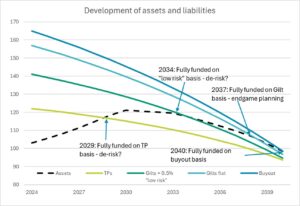
The graph below shows an example of how scheme assets are expected to progress, relative to different liability measures, over the next 20 years for a particular scheme in this situation. We can see the assets grow quickly over the next few years as contributions are paid in. They continue to move steadily through the stronger funding targets based on modest asset performance alone.
Is your strategy ’FIT’ for purpose?
Another critical element of your strategy is to ensure that your destination includes both a clearly defined funding target and a corresponding low-risk investment strategy. To put it another way, a funding and investment target (‘FIT’)
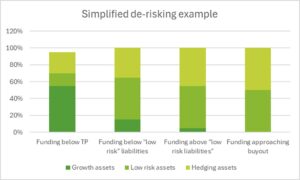
In the same way as the funding position strengthens over time, investment risk should be reduced as your scheme matures. You can do this in a number of ways, including:
– Gradual de-risking (e.g. every quarter) towards the destination strategy.
– Stepped de-risking (e.g. every three years).
– Trigger de-risking based on funding improvements. You can use triggers on their own or in addition to other rebalancing approaches.
Whatever method you use, it is essential to allow for the impact of de-risking on future asset returns. We have illustrated below a simplified example of a de-risking journey:
Let’s talk asset classes – the underperforming schemes’ time to shine
If you have found yourself in the position of being underfunded, now is definitely not the time to despair. While growth asset classes may not be receiving the focus they once had, there are still plenty of opportunities in this area, which has developed significantly since the days when global equities were the only game in town. From structured equity to junior debt and from emerging markets to cryptocurrency, make sure you fully understand your target portfolio and don’t forget to diversify!
Know your limits
The limiting factor for any strategy is risk. Overall risk should be within the employer’s risk capacity both at outset and over the period until low dependency is reached.
Here, it is essential that you capture all risks. Make sure that you compare different potential strategies on a like-for-like basis.
Bridging the gap
Once you understand the scale of the challenge and your risk capacity, you can start looking at different strategies to bridge the gap.
Based on the same scheme used in our earlier example, the following graph shows how you can close a £64m buyout deficit. It uses a 15-year plan involving gradual de-risking, supported by member options and scheme experience, including transfers.
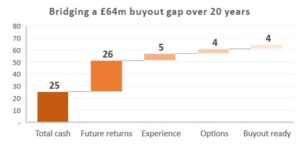
It is essential to understand the reliance on each component and the overall risk involved. In general, greater reliance on time and asset returns means more risk. However, unless your scheme has already achieved buyout, your strategy will involve some level of risk. The key is that all risk-taking should be fully informed, aligned with your objectives and managed within limits to keep you on target.
Taking the first step
Don’t worry if the ultimate destination of buyout seems too far off – you can start by targeting low dependency. The key thing is to get a strategy in place, then push forward towards your ultimate destination.
So don’t delay, the future starts today! To discuss the opportunities for your scheme, contact:
Steve Button, MHM Trustee Services, T: 07952 035538 E: steve.button@mhmtrustees.co.uk
Yona Chesner, Cartwright, T: 07502 999313 E: yona.chesner@cartwright.co.uk
Back