

The Continuous Mortality Investigation (CMI), a subsidiary of the Institute and Faculty of Actuaries, has released its latest mortality improvement model. This model results in lower life expectancies than previous versions, due to more weight being placed on post-pandemic experience.
What is a mortality improvement model?
Mortality assumptions generally consist of two parts:
- A mortality ‘base table’, which provides life expectancies at a specific date.
- A mortality ‘improvement model’, which predicts how life expectancies are expected to change in the future.
The actuarial profession produces a new improvement model each year to include the most recent mortality data.
How are the recent high level of deaths allowed for?
Deaths in 2020 and 2021 were significantly higher than expected, and no weight is placed on these years in the default version of the new model.
Deaths in 2022 and 2023 were higher than in 2019 – the last pre-pandemic year – but not significantly so.
When choosing how to allow for deaths in 2022 and 2023, there are three options:
- Place no weight, which assumes that experience from 2022 and 2023 gives no indication of future mortality trends.
- Place full weight, which assumes that experience from 2022 and 2023 is fully representative of future mortality trends.
- Something in between.
The default version of the model places some weight on data from 2022 and 2023. This results in life expectancies that are a little over halfway between a 0% and a 100% weight.
What does this mean for life expectancies?
The chart shows the projected life expectancies for a 65-year-old using the last four versions of the model:
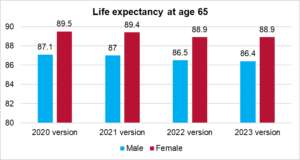
Technical bit: Life expectancies are as at 1 January 2024, derived using S3PxA mortality tables, using the default version of the CMI model with a long-term rate of improvement of 1.25% pa.
What should I be doing now?
Trustees
Trustees who are midway through a current valuation may have adopted the 2020 version of the model at their last valuation. They are likely to see a significant fall in life expectancy at this valuation, potentially over 6 months for some members. In isolation, this could reduce the value placed on the scheme’s liabilities by between 3% to 4%.
Trustees should discuss with their advisers how adopting the latest model could have an impact on their valuation results. Care should also be taken in choosing a suitable ‘base table’, which can be done using mortality and postcode analysis.
Trustees will want to ensure that their overall assumptions reflect the profile of the membership and include an appropriate level of prudence.
Employers
Employers are likely to have adopted the 2021 or 2022 version of the model for their previous year’s accounting disclosures.
Adopting the most recent version of the model is also likely to result in a fall in life expectancies of a few months, reducing the value of an employer’s accounting liabilities by up to 1%.
Employers should ask their advisers what impact allowing for the latest version of the model will have on their accounting disclosures. Employers may also want to raise this with their auditors, to see whether there is an expectation that the most recent version of the model should be used.
Get in touch
Our thanks to Craig Moran at First Actuarial for contributing this article. To discuss funding issues in relation to your scheme, please contact:
|
Steve Button Director MHM Trustee Services E: steve.button@mhmtrustees.co.uk T: 07952 035538 |
Craig Moran Actuary First Actuarial E: craig.moran@firstactuarial.co.uk T: 0161 348 7468 |