
For this feature, we are grateful to Nick Tinker, a specialist covenant adviser at Mercer, for his insights into what the new funding code says about the employer covenant and how trustees should go about assessing this in future.
If you have any questions about this, please get in touch with your usual contact at MHM or contact Nick directly or via the Mercer link below.
Over to you, Nick…
Employer Covenant in The Brave New World
The long-awaited new Defined Benefit Funding Code (the “Code”) is now in place and will apply to schemes with triennial valuations from 22 September 2024. The Code’s contents were well-trailed following an extended consultation period, albeit a number of changes were made to the final Code.
For employer covenant, the Code introduces a number of new concepts, including Reliability and Longevity, to drive a more forward-looking approach to covenant assessment and greater integrated risk management, drawing together covenant, funding, and investment. A third concept, Visibility, was dropped in one of the changes made following the consultation. TPR is due to issue standalone covenant guidance in the coming weeks, having been delayed several months as a result of the General Election.
Our focus here is on Reliability and Longevity, which are key elements in forming a scheme’s long term journey plan, appropriate funding target and investment de-risking strategy.
The chart below shows how employer covenant underpins a scheme’s route to significant maturity, which is the date when the scheme’s duration of liabilities is expected to be no more than 10 years and the scheme investment strategy should target a low dependency asset allocation. For context, TPR’s expectations are that Reliability will be no more than three to six years and longevity no more than 10 years for the majority of schemes
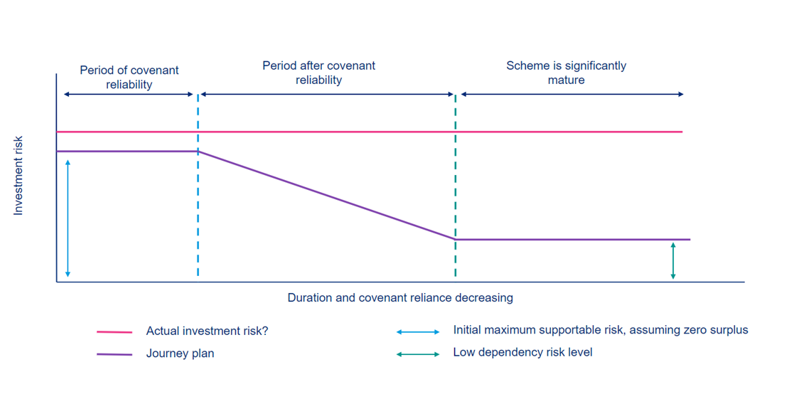
In short, Trustees will need much more information than a single covenant rating to conclude a valuation. Trustees will now also need to form an assessment of Reliability and Longevity, and as a result many schemes will now need to take objective, independent, proportionate covenant advice as part of the triennial valuation process.
 Reliability
Reliability is a measure of the number of years that trustees are comfortable that their scheme’s sponsor can generate levels of free cash flow to sufficiently support the scheme. Covenant Reliability should then be used to consider whether the level of funding and investment risks being run by the scheme remains appropriate.
Assessing Reliability
The key to understanding Reliability is obtaining a clear view of the sponsoring employer’s current and future levels of cash generation, adjusting for one off / exceptional items and ongoing capital investment, to derive the level of cash the sponsoring employers could use to fund the scheme and ultimately underpin scheme risk. Not all sponsors routinely prepare detailed cash flow forecasts – commonly smaller companies and subsidiaries of larger groups – and in these cases it is often reasonable to use a proxy, such as EBITDA (Earnings Before Interest Depreciation and Amortisation)
When reviewing sponsor forecasts, trustees will need to think about material risks that could have an impact on the employer and / or its industry. For example, a sponsor’s reliance upon a few material contracts with near-term end dates, and structural and/or regulatory challenges to its industry, could pose material down-side risks. Where material risks are identified, Reliability will reduce and trustees will set a journey which derisks to a low dependency position more quickly. This will translate into a more prudent funding target.
For trustees who do not already receive non-public financial information, suitable information sharing protocols could be sought. This also has benefits for the sponsor, as increased transparency will improve the prospects of complying with the Code and reduce the risk of falling foul of the Pension Schemes Act 2021, where material corporate activity needs to be reported to trustees on a timely basis.
Longevity
Longevity represents the maximum period that trustees can reasonably assume the sponsor will remain in existence to support the scheme.
Assessing Longevity
As part of a covenant review, trustees could consider assessing the following to understand covenant longevity:
- future trading prospects (which should already be known, underpinning covenant Reliability);
- current levels of liquidity and banking covenant headroom;
- future refinancing risk;
- credit ratings and implied risk of default (as available);
- wider industry trends which could provide an indication of the likelihood of financial distress; and
- potential climate change impacts on the strength of the covenant.
Proportionate insolvency analysis to estimate a scheme’s potential recoveries will help identify downside risk exposure, enabling trustees to think about the reliance that can be placed on a scheme’s exit covenant in the context of the funding and investment risk. This is one of a number of aspects of the new Code where independent covenant advice can add real value in expanding upon the trustees’ knowledge of the sponsor.
For climate related risks, TPR advocates a proportionate approach. With many schemes now benefitting from stronger funding positions, the prospect of climate related risks materially impacting employer covenant in the short to medium term has reduced. In these circumstances, trustees could utilise public information for a high-level overview of climate-related risks and opportunities over short, medium and long-term periods.
What should I do next?
The new Code places significantly greater onus on trustees to consider covenant, funding, and investment in an integrated way. For many schemes, this new, more prescriptive approach means that, for many, it will be challenging to complete a valuation without commissioning some level of independent covenant advice.
At Mercer, our covenant team provides advice to trustees for valuations, corporate events, and scheme events. We work with a broad range of schemes across many industries, including scheme whose liabilities range from less than £1m to more than £1bn.
We also advise sponsors, helping them navigate this increasingly regulated space, including valuations, transactions, and group reorganisations.
We provide cost-effective, clear, pragmatic, and actionable advice. We work closely with many different advisory firms so you can be confident that we can meet your needs.
Please do contact us if you would like to talk about any aspects of the above and how we can help you.
Mercer Limited is authorised and regulated by the Financial Conduct Authority. Registered in England and Wales No. 984275.
Registered Office: 1 Tower Place West, Tower Place, London EC3R 5BU
Copyright © 2024 Mercer Limited. All rights reserved.
This does not constitute an offer or a solicitation of an offer to buy or sell securities, commodities and/or any other financial instruments or products or constitute a solicitation on behalf of any of the investment managers, their affiliates, products or strategies that Mercer may evaluate or recommend.
For the avoidance of doubt, this paper is not formal investment advice to allow any party to transact. Additional advice will be required in advance of entering into any contract.
The opinions expressed herein are the intellectual property of Mercer and are subject to change without notice.
Back