Most UK pension schemes hold corporate bonds – debt issued by companies – in their investment portfolios. For schemes targeting an insurer buy-out, corporate bonds may be used to help the scheme mimic the pricing bases at the bulk annuity insurers. Or if the scheme has a deficit to close, corporate bonds could be included as they are typically expected to generate higher returns than government bonds – known as gilts – over the longer term.
But the expected return from corporate bonds, particularly high-quality (investment grade) bonds, has decreased over the last few years. We asked Momentum, the UK-based investment manager and consultant, for their thoughts on alternative investment options to help pension schemes achieve higher expected returns without a significant increase in risk.
Introduction
The excess return (or spread) over gilts expected on investment grade (IG) corporate bonds has reduced considerably over recent times and is currently well below long-term average levels[1]. Corporate bonds continue to play a helpful role in providing this excess return as well as contributing to interest rate hedges and forming part of the asset pools backing Liability Driven Investment (LDI) programs. However, with the backdrop of these lower returns, what other options are there for corporate bond investors, like our clients?
In a number of cases, we have favoured high quality, liquid Asset Backed Securities (ABS) which offer a higher credit spread than equivalent quality conventional corporate bonds. This has to be balanced against the shorter credit spread duration of these securitised assets, and the associated reinvestment risk, but we believe overall investors are well compensated at current market conditions.
The minimum size of investment in pooled ABS funds start at c.£1m, and there is no minimum term to hold the investment, so these are accessible to most institutional investors. Fees are also competitive, relative to investment grade corporate bonds, with annual management charges starting from 0.1% for high-grade ABS mandates.
What are ABS?
In short, ABS are another type of bond. The key characteristics are that they are secured on some form of collateral and structured so that they tranched in a subordinated sequence (higher priority for senior debt).
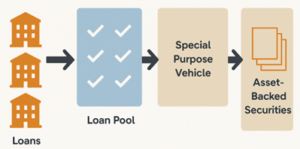
ABS is a broad term used to describe a form of lending (debt instrument/bond) that is secured on some form of collateral (pool of loans), also commonly referred to as securitised credit. The collateral is ring-fenced from a legal perspective through a Special Purpose Vehicle (SPV) and is used to pay back the investor through interest (coupon) and maturity (principal) payments. The debt instruments/bonds are packaged by priority of payment to allow investors to choose where along the risk/return spectrum they wish to operate.
The diagram below illustrates the pooling of loans (source: MGIM).
The coupon payments are typically paid on a quarterly basis and linked to a floating rate of interest. The principal payments are normally paid gradually over time (amortised).
The main types of collateral are:
- Residential and consumer loans (e.g. residential mortgages, car loans, credit card receivables and student loans);
- Commercial real estate loans (e.g. commercial mortgages); and
- Corporate loans (e.g. collateralised loan obligations).
The collateral provides additional security to the investor. If the borrower defaults, then the underlying assets of the collateral pool can be sold to repay the investor.
Example structure
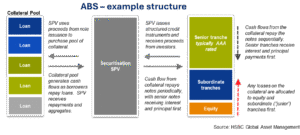
An example of a typical ABS structure is illustrated in the diagram below.
 Taking each of these in turn:
- Collateral pool – this comprises the packaging of similar individual loans. For example, an individual loan could be a residential mortgage i.e. a bank lending capital to an individual to acquire / remortgage their home. In this case, the collateral pool would amalgamate numerous individual residential mortgage loans.
- Special Purpose Vehicle (SPV) – the collateral pool (packaging of individual loans) would be held in an SPV. This is a separate company/trust that is created and ring-fenced (bankruptcy-remote) from the bank. This provides investors with additional protection should the bank fail.
- Securitisation and Tranching – ABS are created by the SPV (backed by the numerous individual loans packaged in the collateral pool) and sold to investors. The ABS are tranched based on the repayment terms (i.e. how soon investors receive back their capital), albeit backed by the same pool of collateral. Each tranche will have different risk and return characteristics. For example, the senior tranche of the capital structure, typically AAA-rated, will be repaid first to investors. Therefore, the risk and return of the senior tranche will be the lowest relative to all the other tranches.
Why consider investing?
ABS are a good alternative to investment grade corporate bonds, typically achieving a return premium relative to investment grade corporate bonds for similar credit quality, in part due to a complexity premium. They produce a regular level of contractual income, and cash flows are linked to a floating rate of interest so there is minimal exposure to interest rate risk.
The ABS market is large and deep, and issuance remains strong as banks increasingly face more pressure to streamline their balance sheets. The total size of the global market that is investable is c$3.8tn[1], dominated by the US market followed by Europe and Australia. Historical performance has shown that ABS have a very low default rate, even through several economic cycles, particularly in Europe.
Investors typically access ABS exposure through pooled funds to ensure appropriate diversification. There are no explicit set-up costs to invest, save the transaction costs incurred by acquiring assets.
Some investors have been reluctant to invest in ABS given the perceived association with the Global Financial Crisis (GFC) in 2008. However, the GFC was largely predicated around US subprime mortgages and Credit Default Obligations[2]. The loose regulations around these instruments allowed financial firms to take on large amounts of leverage and develop a string of complex derivatives products with very little transparency. This would not be possible today, with the stringent capital requirements and clarity of structure required from financial products.
As with any bond investment, there are risks involved, including the underwriting of credit risk and investors should not be overly reliant on attractive loan-to-value ratios and asset prices. Investors can mitigate risks by seeking exposure to diverse pools of collateral (reducing idiosyncratic default risks from individual loans) and by selecting the tranche of debt that is most appropriate for their needs (e.g. senior tranches are typically shorter dated, have higher ratings and a greater cushion against loss).
Summary
Investors seeking a diversified return pick-up over investment grade corporate bonds, with the same or lower risk (measured by credit rating), could consider including ABS markets as part of a diversified bond or LDI portfolio.
To discuss this further, please contact Raj Goswami or Gary Yeaman at Momentum using the details below.
Back